STORM Platform · Threat Intelligence

Turn external signals into usable context.

Explore emerging vulnerabilities, publicly disclosed breaches and supplier-related threat signals in one workspace—then use that visibility to support risk assessment and remediation decisions.

STORM documents periodic feed synchronisation—not guaranteed real-time streaming. Geographic breach filtering is explicitly documented for Greece; wider geographic coverage should be confirmed.

Threat landscapeSignals connected
Vulnerability signalSeverity, CVSS, vendor and product
Disclosed breachIncident and geographic context
Supplier signalBreach and vendor exposure
CVE ExplorerSearch, filter and review synchronized vulnerability records.
Breach viewMonitor publicly disclosed security incidents.
Supplier signalsTrack third-party breaches and vendor-specific vulnerabilities.
Periodic syncRefresh public threat-intelligence feeds on a periodic basis.
From volume to relevance

Explore the signal before it becomes a blind spot.

Public vulnerability and breach feeds generate more information than teams can use without a way to search, filter and place it in context. STORM centralizes those records and adds supplier, vendor, severity and geographic perspectives so security teams can investigate what deserves attention.

01 · MONITOR

See the landscape

Use a centralized dashboard for vulnerability trends, severity distribution and key metrics.

02 · EXPLORE

Investigate CVEs

Search vulnerability details and narrow results using documented attributes.

03 · WATCH

Track third parties

Monitor supplier breaches and vulnerabilities associated with specific vendors.

04 · INFORM

Support decisions

Use relevant intelligence to inform risk assessment and remediation activity.

Inside the platform

A searchable view of the evolving threat landscape.

The module combines dashboard visibility, detailed vulnerability exploration and breach intelligence without presenting every external signal as an internal finding.

01 · Central dashboard

See trends, severity and recent signals together.

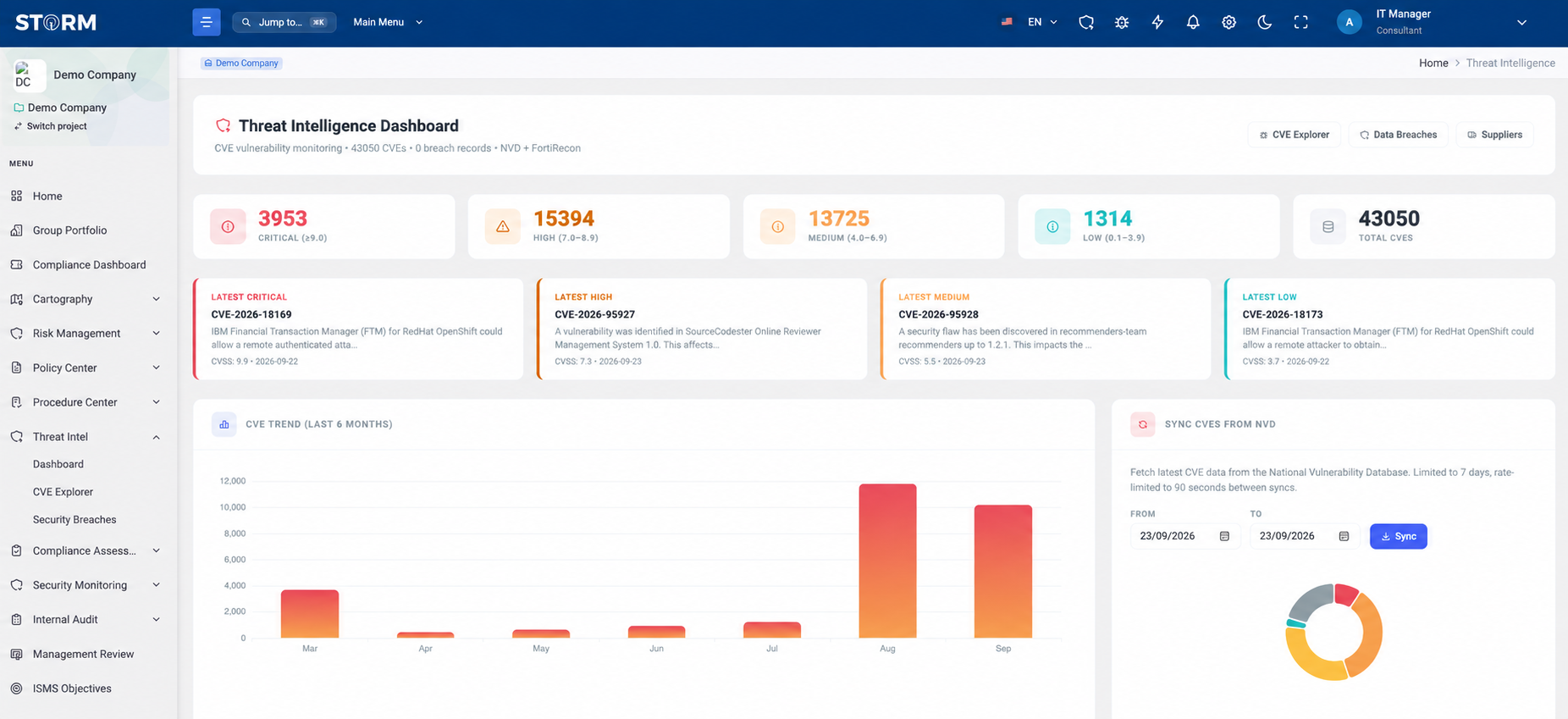
Bring periodically synchronized CVE data and disclosed breach intelligence into a single dashboard. Review vulnerability volumes, severity distribution, recent records and trend metrics before moving into detailed investigation.
  • Current threat-landscape overview
  • Vulnerability trends and severity distribution
  • Key metrics with paths into CVEs, breaches and suppliers
STORM Threat Intelligence dashboard showing CVE severity, trends and breach navigation
02 · CVE Explorer

Filter vulnerability intelligence down to what matters.

Search and review CVE details, then filter by publication date, severity, CVSS score, vendor, product and other available attributes. The result is an investigation view, not a claim that every published CVE affects the organization.

  • Searchable CVE records
  • Date, severity and CVSS filtering
  • Vendor and product perspectives
SeverityCVSSVendorProductPublished
CVE recordVendor · Product · Published date · CVSS details
Critical
CVE recordSearchable vulnerability information and attributes
High
CVE recordReview details before determining organizational relevance
Review
CVE Explorer modelBased on documented capabilities
03 · Breach and supplier monitoring

Watch beyond the organization’s perimeter.

Review publicly disclosed incidents, identify breaches relevant to the organization or its region, and monitor supplier-related security incidents and vendor-specific vulnerabilities. STORM explicitly documents geographic filtering for Greece.

  • Publicly disclosed breach intelligence
  • Supplier and third-party security incidents
  • Geographic breach filtering documented for Greece
Organization relevanceDisclosed incidents that may warrant investigation
Breach
Supplier monitoringThird-party breaches and vendor exposure
Supplier
Geographic contextFiltering for incidents and breaches in Greece
Greece
Breach intelligence modelBased on documented capabilities
04 · FortiRecon intelligence

Add external exposure and supply-chain signals.

The documented FortiRecon integration retrieves external threat and breach intelligence—including dark-web exposure, leaked credentials and vendor or supply-chain risk signals—for use in Threat Intelligence and Third-Party Risk Management.

  • Dark-web exposure signals
  • Leaked-credential intelligence
  • Vendor and supply-chain risk context
FortiReconExternal threat and breach intelligence
Source
Threat IntelligenceDisclosed breach information and external signals
Explore
Third-Party Risk ManagementSupplier evaluation and scoring context
Inform
Documented integration pathCurrent product evidence
From feed to decision

Keep intelligence exploratory, filtered and actionable.

The documented module supports investigation and informed remediation; it does not claim autonomous response.

01

Synchronize

Periodic public-feed updates

02

Explore

CVE and breach records

03

Filter

Severity, vendor, product and date

04

Relate

Supplier and geographic context

05

Inform

Risk and remediation decisions

Product boundary

Clear about what is documented.

Threat-intelligence usefulness depends on feed scope, synchronization frequency and how signals move into the organization’s operational process.

Supported by the product description

  • Public threat-intelligence feeds with CVE and breach records
  • CVE retrieval, periodic synchronization and detailed exploration
  • Date, severity, CVSS, vendor and product filtering
  • Supplier breaches and vendor-specific vulnerability monitoring
  • Geographic incident filtering for Greece
  • Vulnerability trends, severity distribution and key metrics
  • FortiRecon dark-web, leaked-credential and supply-chain signals

Confirm for your deployment

  • Exact public-feed sources, coverage and synchronization interval
  • Real-time streaming or guaranteed update latency
  • Geographic filtering beyond Greece
  • STIX, TAXII, MISP, SIEM, SOAR or EDR connectivity
  • Automated IOC blocking or containment
  • Automatic creation of internal findings, risks or tickets
  • Data retention, licensing and FortiRecon service scope
Practical questions

Test the signals against what your team must investigate.

Bring the vendors, suppliers, products and geographies that define relevance for your organization.

What information does STORM Threat Intelligence aggregate?
The supplied technical description identifies publicly available threat-intelligence feeds, including CVEs and breach intelligence. It also documents supplier-related incidents, vendor-specific vulnerabilities and FortiRecon external-exposure signals.
Are threat feeds synchronized in real time?
The documentation states that threat-intelligence feeds are synchronized periodically. It does not promise continuous real-time streaming or a guaranteed update interval, so timing should be confirmed for the intended deployment.
How can CVEs be filtered?
Documented filters include publication date, severity, CVSS score, vendor, product and other available attributes. The CVE Explorer also supports searching and reviewing vulnerability details.
Can STORM monitor supplier threats?
Yes. STORM documents monitoring security breaches affecting suppliers and third parties, vendor-specific vulnerabilities, and FortiRecon vendor or supply-chain risk signals.
Which geographic filtering is documented?
The technical description explicitly identifies geographic filtering of security incidents and breaches for Greece. Coverage for additional countries or regions should be confirmed rather than assumed.
Does Threat Intelligence automatically remediate threats?
No autonomous remediation, blocking or containment capability is documented for this module. It provides visibility intended to support informed risk assessment and timely remediation activities.
How is this different from Technical Vulnerability Management?
Threat Intelligence explores external vulnerability and breach information. The separately documented Technical Vulnerability Management module centralizes findings from sources such as Nessus and Microsoft Defender and manages prioritization, remediation and SLA-driven workflows against organizational assets.

Bring the suppliers and products your team watches today.

Validate the feed scope, filters, FortiRecon signals and investigation workflow against the external exposure questions that matter to your organization.

Book a STORM demo