EU data protection · STORM GRC
Make privacy obligations operational.
Build and maintain processing records, data maps and DPIAs alongside the systems, suppliers, policies, risks and incident evidence behind your GDPR accountability programme—without separating privacy from the rest of GRC.
STORM supports governance and evidence workflows. It does not replace legal advice or decisions by your Data Protection Officer.
Privacy operating mapConnected context
Assets & processing contextData, systems, services, processes and suppliersCartography
Risk & safeguardsImpact, threats, treatments and control evidenceRisk
Governance & responsePolicies, owners, suppliers and incidentsEvidence
One operating context for privacy, security and complianceSTORM GRC
7 principlesincluding accountability for demonstrating compliance
1 monththe usual deadline for responding to individual rights requests
72 hoursat the latest, where feasible, for qualifying breach notification
Risk-basedsecurity measures and DPIAs depend on processing risk
Article 5 · the foundation
Privacy starts with principles. It survives through evidence.
The GDPR expects organisations not only to follow the data-processing principles, but to be able to demonstrate that they do. That turns privacy into an ongoing governance discipline.
Where STORM fits
Keep privacy connected to the real environment.
STORM brings the operational records around GDPR into the same model used for security risk, compliance, suppliers, policies and incidents.
RoPA & data mapping
Identify personal-data assets, processing activities and data flows, then relate them to systems, services, processes, people, locations and suppliers.
Cartography · RoPADPIA & risk assessment
Run structured impact assessments that consider effects on data subjects and confidentiality, integrity and availability, then connect findings to threats, scenarios and treatments.
DPIA · risk managementPolicy governance
Manage versions, reviews, approvals and acknowledgements, map documents to relevant controls, and issue automated email or Microsoft Teams reminders.
Policy centreSupplier oversight
Assess suppliers through configurable questionnaires, collect control-level evidence, score business impact and security posture, and track remediation in context.
Third-party riskBreach workflow
Record affected assets and services, apply regulatory classification, assign ownership, document root cause and corrective actions, and retain the response timeline.
Incident managementTraceability & reports
Link framework requirements to policies, technical controls, attestations and evidence, then generate RoPA, DPIA, gap, assessment and executive reports.
Compliance & reporting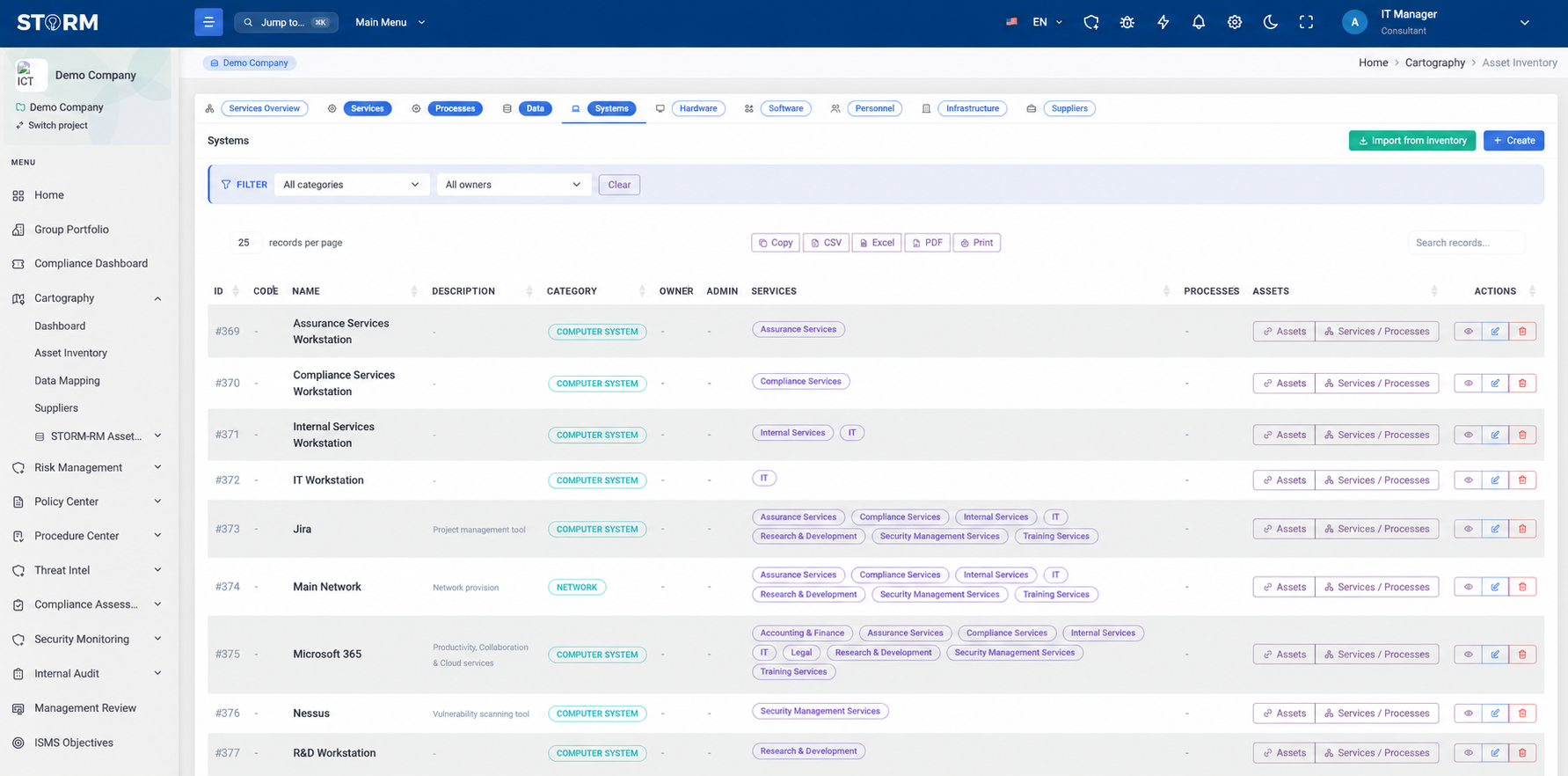 Operational context for systems, services, processes and data
Start with context
Map processing to the environment behind it.
STORM Cartography supports personal-data identification, processing-activity records and data-flow mapping across systems, services, processes and suppliers—creating reusable context for ownership, DPIA, risk and compliance work.
- Prepare and maintain Records of Processing Activities
- Visualise data flows and asset dependencies
- Export asset and processing records in standard formats
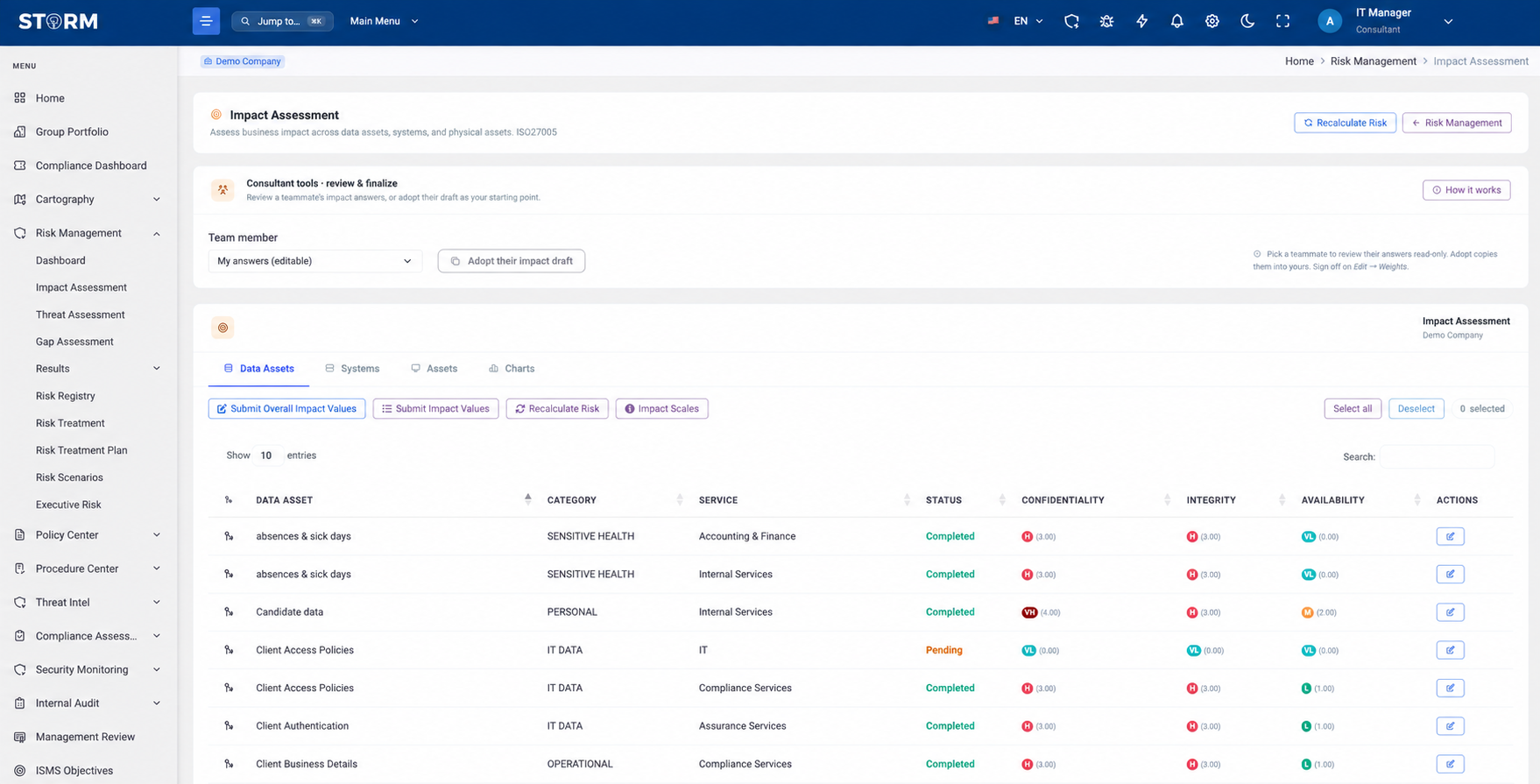 Impact assessment across data assets and systems
Assess what matters
Run DPIA inside the risk model.
STORM provides structured questionnaires for evaluating impact on data subjects and the consequences of losing confidentiality, integrity or availability. Results feed scenarios, treatments and residual-risk decisions instead of creating a detached privacy assessment.
- Conduct and report Data Protection Impact Assessments
- Connect impact, threats and vulnerabilities to treatment decisions
- Export reviewable DPIA and assessment results
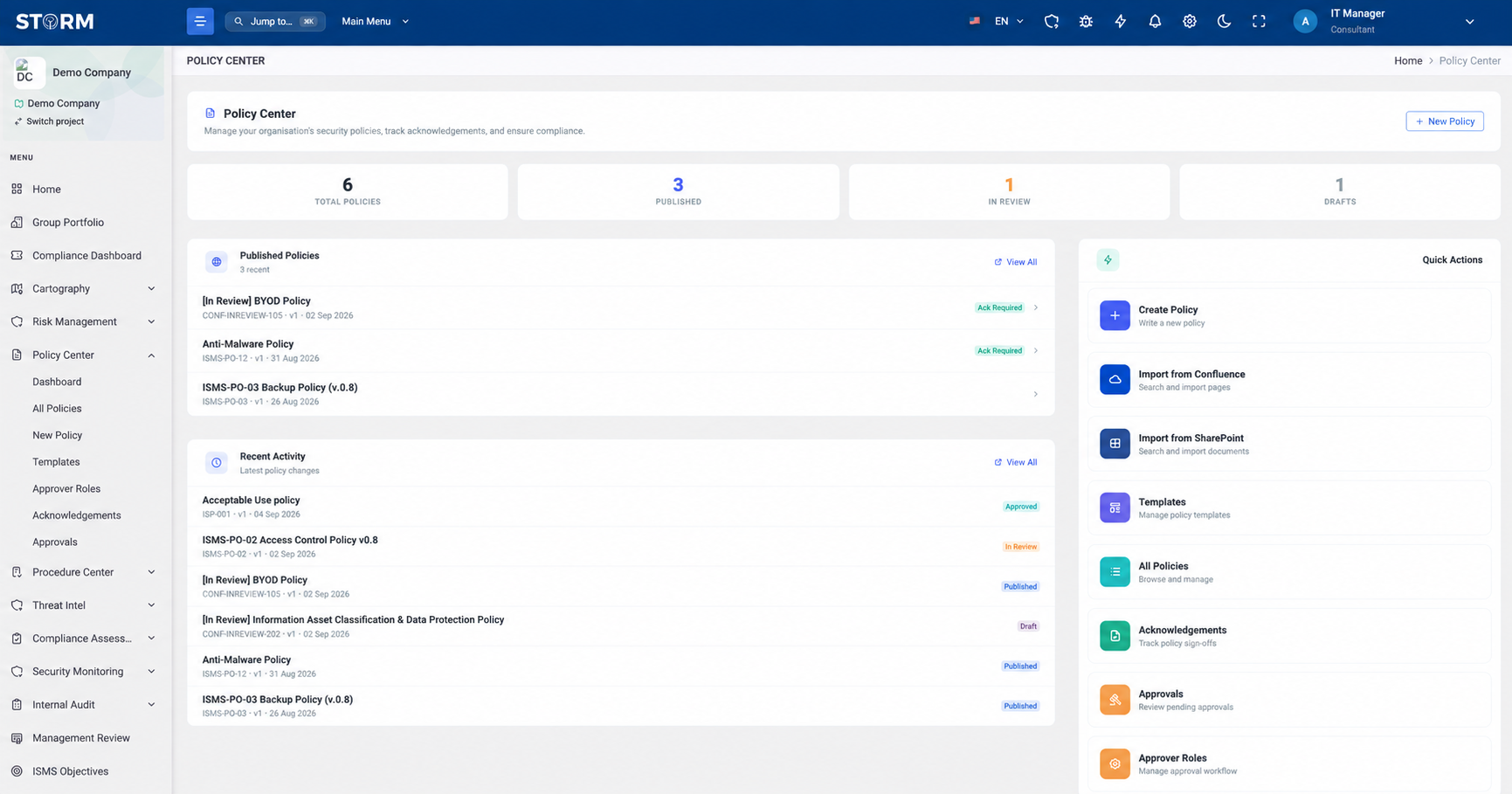
Govern and respond
Keep decisions, breaches and actions reviewable.
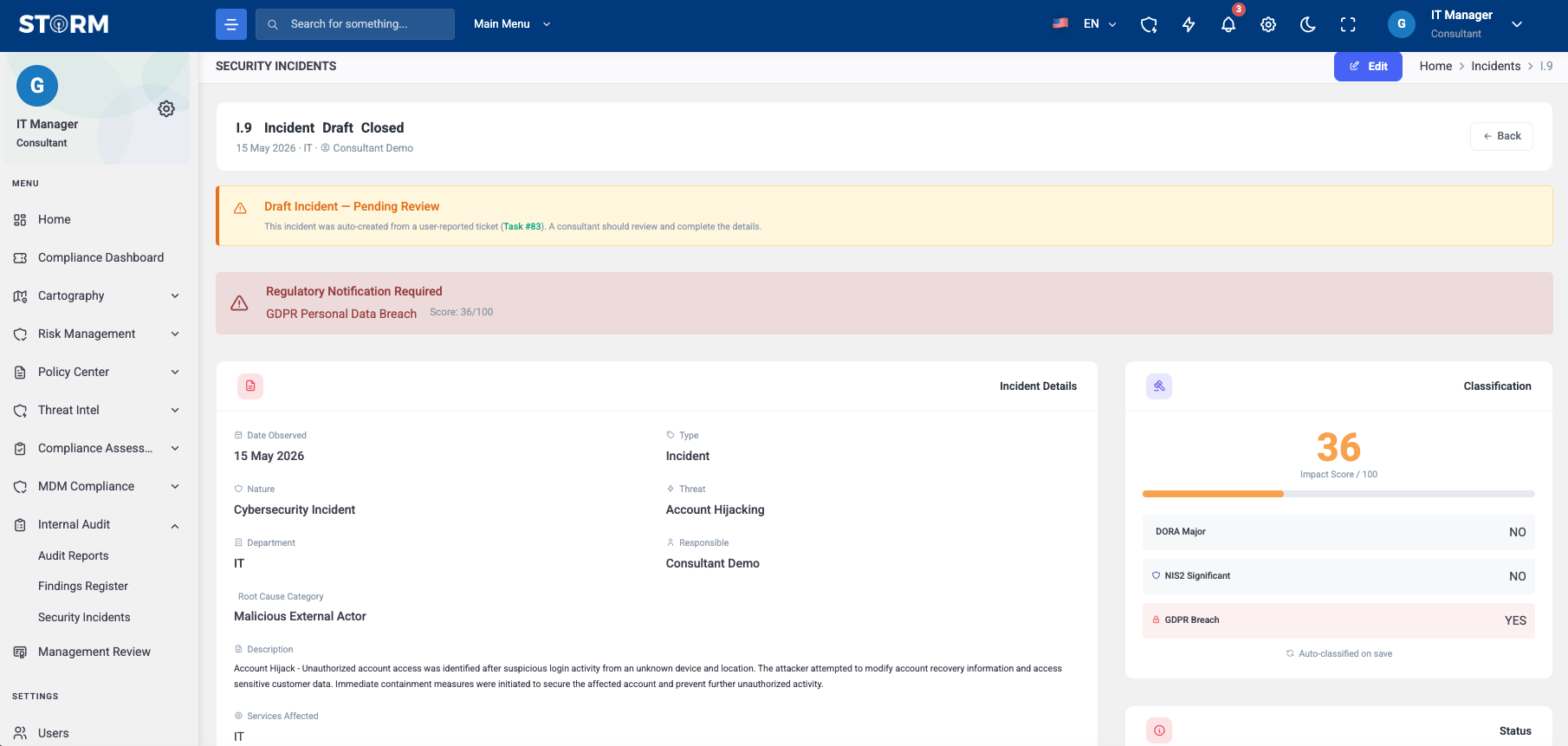
Policy lifecycle and incident records share the same asset and risk context. The incident workflow supports regulatory classification, affected-asset linkage, root-cause analysis, target dates and corrective actions, while policy evidence retains its approvals and acknowledgements.
- Versioned policy reviews, approvals and acknowledgements
- GDPR incident classification and accountable ownership
- Corrective actions, dates and evidence retained through closure
Regulation to operating context
Article 5
Articles 24–25
Article 30
Article 32
Articles 33–34
Article 35
The obligations stay legal. The work becomes traceable.
STORM does not interpret the law for your organisation. It helps organise the governance, security and evidence records that privacy teams depend on.
Principles & accountability
Operational support: connect policies, controls, owners, assessments and evidence so compliance decisions can be reviewed rather than reconstructed.
Responsibility, design & default
Operational support: use asset context, risk assessment, policy governance and treatment actions to evidence how safeguards are considered and maintained.
Records of processing activities
Operational support: identify processing activities and personal-data assets, map flows and dependencies, maintain accountable context and generate a RoPA report. Legal completeness remains the controller's or processor's responsibility.
Security of processing
Operational support: assess risk, record safeguards and treatments, maintain policies, monitor relevant control evidence and review supplier security in context.
Personal-data breaches
Operational support: maintain a linked incident record with regulatory classification, affected assets and services, automated impact scoring, ownership, root cause, corrective actions and resolution dates. Your team determines notification obligations and communications.
Data protection impact assessment
Operational support: conduct a structured DPIA using data-asset, processing, supplier, impact, threat and treatment context, then retain and export the assessment record. Your organisation determines when a DPIA is required and whether it is legally complete.
The summaries above are operational signposts, not legal interpretations. Always assess applicability against the official regulation, EDPB guidance and advice from qualified privacy professionals.
Practical questions
Know what STORM does—and what your team must decide.
A trustworthy GDPR workflow keeps product capability, legal responsibility and organisational judgment clearly separated.
Does STORM make an organisation GDPR compliant?
No software can make that determination on its own. STORM supports the asset, risk, policy, supplier, incident, compliance and evidence workflows around an accountability programme. Legal interpretation, lawful-basis decisions and final responsibility remain with the organisation and its qualified advisers.
Does STORM support RoPA and DPIA?
Yes. STORM's documented capabilities include personal-data identification and mapping, Records of Processing Activities, data-flow diagrams, structured DPIA and exportable DPIA reports. This page does not claim a dedicated data-subject request intake portal, and the organisation remains responsible for the legal completeness of every record and assessment.
When is a DPIA required?
Article 35 requires a DPIA before processing that is likely to result in high risk to individuals' rights and freedoms. STORM can organise relevant asset, supplier, impact, threat and treatment evidence; the organisation must decide whether a DPIA is required and ensure its legal completeness.
Does every personal-data breach have to be reported within 72 hours?
No. Controllers notify the supervisory authority without undue delay and, where feasible, within 72 hours after awareness when the breach is likely to create a risk to individuals' rights and freedoms. High-risk breaches may also require communication to affected individuals. Processors notify the controller without undue delay.
Can STORM connect privacy work with the wider security programme?
Yes. STORM's documented operating model connects cartography, impact and threat assessments, risk scenarios, treatment plans, policies, suppliers, incidents, control evidence and reporting. That shared context is the central value of using STORM for privacy governance.
Bring your privacy workflow
Book a STORM demo
See GDPR governance in the same context as risk.
Use a focused walkthrough to test STORM against your assets, suppliers, risk method, policies, incident process and evidence requirements.