STORM Platform · Third-Party Risk Management

Know which suppliers matter—and where to act.

Centralize supplier records, assess business impact and security posture, classify risk, collect supporting evidence and move material findings into accountable remediation.

FortiRecon and BitSight are documented integrations for external supplier-risk signals. Their availability, licensing and configuration should be confirmed for each deployment.

Supplier risk workspacePortfolio connected
0–8
Two dimensions. One decision view.

Business impact and security posture combine into a supplier score, tier and documented action path.

ImpactBusiness
PostureSecurity
TierPriority
EvidenceOversight
Supplier assessmentQuestionnaire · evidence · external signals
Assessed
Remediation planRisk · owner · follow-up action
Tracked
Supplier inventoryMaintain a centralized repository for third-party records.
Configurable methodEvaluate business impact and security posture with tailored criteria.
Signals + evidenceCombine questionnaires, attachments and documented external sources.
Tiered actionUse scores and tiers to guide monitoring or remediation.
From list to defensible oversight

One supplier view. Two risk dimensions. A clearer decision.

A questionnaire alone cannot explain how much a supplier matters or what external exposure changes the decision. STORM connects the supplier record with business impact, compliance responses, vulnerability exposure, disclosed breaches and supporting evidence so risk tiers are tied to visible inputs.

01 · REGISTER

Centralize suppliers

Maintain supplier details, categories, relationships and risk status in one repository.

02 · ASSESS

Measure impact

Apply configurable weighted business-impact criteria and assessment workflows.

03 · ENRICH

Add security posture

Bring together compliance, vulnerability and breach perspectives.

04 · ACT

Prioritize follow-up

Use risk tiers to guide monitoring, remediation planning or escalation.

Inside the platform

Supplier risk that stays connected to the evidence.

The documented workflow combines inventory, configurable assessment, external security context, tiering, reporting and remediation oversight.

01 · Supplier inventory

Give every third party a governed home.

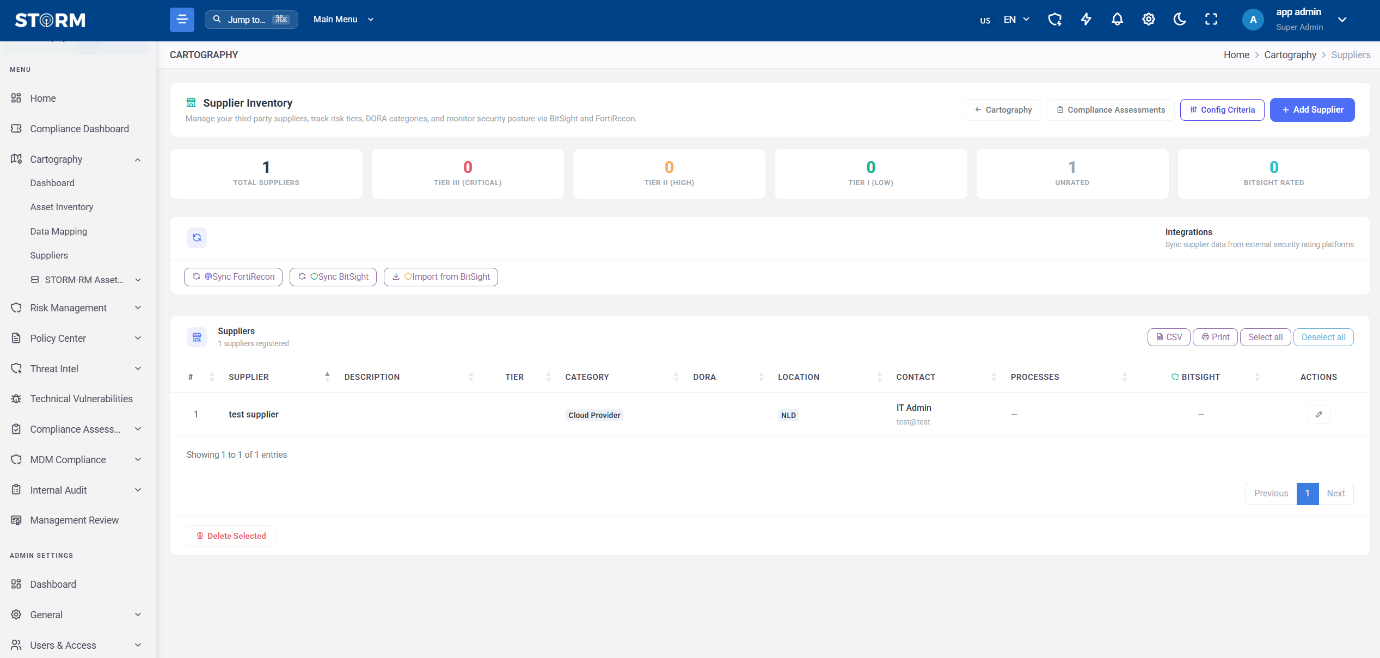
Maintain supplier details in a centralized repository, connect records with processes and services through Cartography, and keep categories, locations, contacts, tier status and available external-rating context visible.
  • Centralized supplier repository
  • Cartography process and service relationships
  • Portfolio-level tier and monitoring visibility
STORM Supplier Inventory showing portfolio metrics, integration actions and supplier records
Supplier InventorySTORM product interface · sample data
02 · Configurable risk methodology

Separate supplier importance from supplier security.

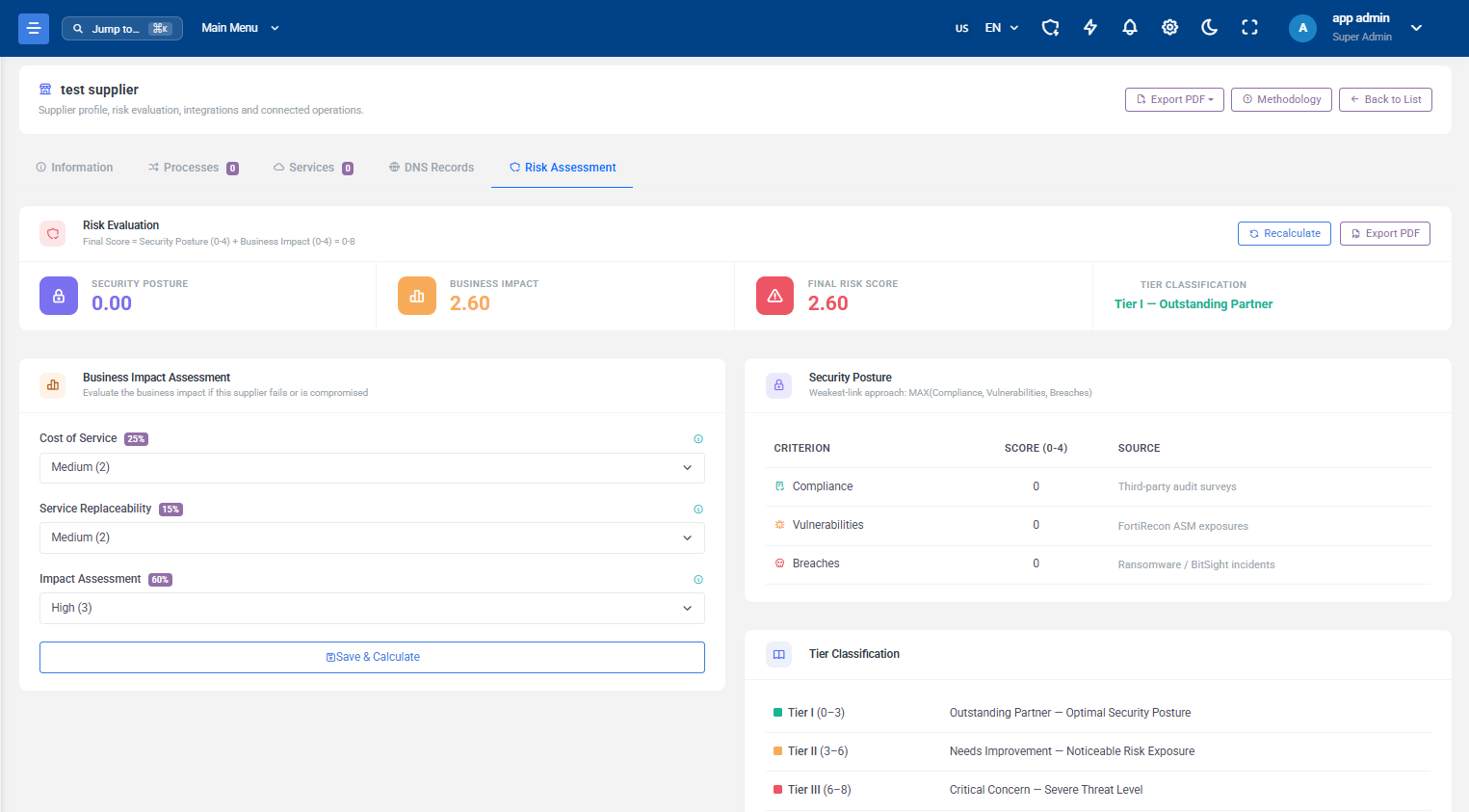
Evaluate each supplier across Business Impact and Security Posture. Business Impact uses configurable weighted criteria, while Security Posture applies a documented weakest-link approach across compliance survey results, vulnerability exposure and security breaches.
  • Configurable weighted business-impact criteria
  • Compliance, vulnerability and breach posture inputs
  • Combined final score from 0 to 8 with three tiers
STORM supplier risk assessment showing business impact, security posture, final score and tier classification
Supplier Risk AssessmentSTORM product interface · sample data
03 · Questionnaires and evidence

Let suppliers participate without losing oversight.

Use configurable supplier questionnaires and evaluation workflows. Through the documented Supplier Portal, suppliers can respond against selected frameworks, report implementation status and upload supporting evidence for individual controls.

  • Supplier self-assessment questionnaires
  • Framework-based implementation status
  • Control-level attachments and downloadable evidence
01
AssignSelect the assessment and supplier workflow
Invite
02
RespondRecord implementation status by control
Assess
03
SubstantiateUpload and review supporting evidence
Evidence
Supplier assessment workflowQuestionnaire → response → evidence
04 · External security context

Add outside-in signals to the supplier record.

Use documented FortiRecon and BitSight integrations to retrieve external threat, breach or security-rating context for third-party monitoring and scoring. These signals inform the assessment; they do not replace the business-impact or compliance view.

  • FortiRecon threat, breach and supply-chain signals
  • BitSight external security ratings
  • Third-party risk monitoring dashboard
Documented integrationsExternal signal → supplier context
05 · Tiering, reporting and remediation

Turn the result into an accountable next step.

Use the combined score to classify suppliers into three documented tiers and guide continuous monitoring, remediation planning or immediate action. Supplier risks can also be managed in the Risk Registry with owners, controls, treatment details, review dates and attachments.

  • Three-tier supplier classification
  • PDF and CSV supplier assessment exports
  • Linked risk ownership and remediation records
I
Tier IOutstanding Partner · continuous monitoring
0–3
II
Tier IINeeds Improvement · remediation planning
3–6
III
Tier IIICritical Concern · immediate action / exit strategy
6–8
Documented tier modelScore → tier → action path
From supplier record to action

Keep every risk decision connected and explainable.

STORM preserves the inputs behind each tier so teams can see why a supplier was prioritized and what follow-up the result requires.

01

Register

Supplier and relationship context

02

Assess

Business impact criteria

03

Collect

Questionnaire and evidence

04

Enrich

External security signals

05

Classify

Final score and risk tier

06

Act

Monitor or remediate

Product boundary

Clear about what is documented.

Validate methodology settings, questionnaire content, integration prerequisites and remediation governance against the third-party programme you intend to run.

Supported by the product description

  • Centralized supplier inventory and repository
  • Configurable assessment methodology and weighted business-impact criteria
  • Weakest-link security posture based on compliance, vulnerabilities and breaches
  • Combined 0–8 score and three supplier risk tiers
  • Questionnaires, evaluation workflows and supplier evidence
  • Monitoring dashboard with FortiRecon and BitSight integrations
  • Compliance Assessment and Cartography integration
  • PDF and CSV supplier risk reports with remediation oversight

Confirm for your deployment

  • Exact criteria, weights, thresholds and organization-specific methodology configuration
  • Framework questionnaire content and supplier access model
  • FortiRecon and BitSight licensing, API coverage, refresh cadence and data availability
  • Automated supplier discovery, procurement, spend, contract or renewal management
  • Sanctions screening, financial-health monitoring or fourth-party relationship mapping
  • Automated execution of supplier exit or autonomous remediation
  • Whether a specific regulatory obligation is fully met—STORM supports evidence and workflow, not legal conclusions
Practical questions

Validate the model with a real critical supplier.

Bring one supplier, its service relationship, a completed questionnaire, representative external signals and an open remediation action to the walkthrough.

How does STORM calculate third-party risk?
The documented methodology combines Business Impact and Security Posture into a final score from 0 to 8. Business Impact uses configurable weighted criteria; Security Posture uses the weakest result across compliance surveys, vulnerability exposure and security breaches.
Which supplier tiers are documented?
Tier I covers scores 0–3 and supports continuous monitoring, Tier II covers 3–6 and points to remediation planning, and Tier III covers 6–8 and indicates immediate action or an exit strategy. Boundary handling at exact threshold values should be confirmed during configuration.
Can suppliers complete their own assessments?
Yes. The Supplier Portal is documented for framework-based questionnaires, implementation-status responses and control-level supporting evidence. Exact access, invitation and authentication arrangements should be confirmed.
Can supporting evidence be collected?
Yes. Suppliers can upload attachments for individual controls, and the submitted evidence can be downloaded by suppliers and consultants according to the documented workflow.
Which external integrations support supplier risk?
FortiRecon is documented for external threat and breach intelligence, including supply-chain risk signals. BitSight is documented for external security ratings used in supplier security-posture evaluation and scoring.
Does an external rating determine the full supplier score?
No. The documented method also considers business impact, compliance surveys, vulnerability exposures and security breaches. Exact scoring configuration should be reviewed for the intended deployment.
Can supplier risks be tracked beyond the assessment?
Yes. The Risk Registry supports risks derived from TPRM, including likelihood, impact, controls, mitigation plans, treatment strategy, ownership, review dates and attachments.
Which TPRM report formats are documented?
The TPRM capability list explicitly documents PDF and CSV exports for supplier risk assessment reports.

Bring one critical supplier and one open concern.

Validate the supplier record, business-impact criteria, questionnaire evidence, external security context, tier result and remediation path against your operating model.

Book a STORM demo