STORM GRC vs Formalize

Put security operations inside your GRC model.

Both platforms publish connected workflows for risk, compliance, incidents, suppliers, policies and continuity. STORM stands out when that operating model must also include dedicated phishing exercises, threat intelligence, security monitoring, maritime workflows and a path to discuss on-premise deployment.

Source-backed comparison · Formalize information links to Formalize's official website and help center · Reviewed 30 September 2026

Platform snapshotPublished capabilities
STORM GRCSecurity operations included

Twelve connected modules sharing the same asset, control and risk model.

Risk & complianceAudit & incidentsSuppliers & BCPThreat intel & phishing
FormalizeCompliance operations

Connected compliance and GRC with configurable workflows across governance and resilience.

Risk & incidentsPolicies & frameworksThird-party & dataContinuity & workflows
STORM focusGRC plus built-in security operations
12 modulesOne shared data model
5 phasesAsset map to monitoring
EU-hosted SaaSEU jurisdiction
On-premiseDiscussed for strict locality
Why teams choose STORM

When GRC must see the security picture.

STORM is designed for teams that want governance data and operational security context to work together—from asset cartography and risk to endpoint evidence, threat intelligence and board reporting.

GRC plus security operations

Threat intelligence, phishing exercises and security monitoring sit alongside compliance, risk, audits, incidents and continuity.

Platform scope

A defined risk journey

STORM publishes a five-phase path from cartography and assessment through treatment, third parties and continuous compliance monitoring.

Operational method

Maritime-ready operations

STORM publishes shore, fleet and per-vessel workflows mapped to IMO MSC.428(98) and IACS UR E26/E27.

Sector-specific scope

A deployment discussion path

STORM publishes EU-hosted SaaS and offers on-premise deployment discussions for strict data-locality requirements.

Deployment choice
Why STORM

Where STORM is the more operational fit.

Formalize publishes substantial GRC and resilience capabilities. This focused comparison therefore highlights only the areas where STORM documents a distinct operational choice.

Decision area
Why STORM stands out
Formalize's published approach
Platform scope
STORM advantage12 modules extending into security operationsCompliance, risk, audit, incidents, assets, suppliers, BCP/DRP, policies, tasks, phishing, threat intelligence and reporting share one asset, control and risk model.STORM source ↗
Connected compliance and GRCFormalize publishes risk, policy, third-party, data-governance and business-continuity capabilities with configurable compliance workflows.Formalize source ↗
Risk methodology
STORM advantageA prescriptive asset-to-monitoring sequenceSTORM's five phases move from cartography to risk management, policies and procedures, third-party risk and compliance monitoring. Assets and dependencies feed impact, threat, treatment and residual-risk work.STORM source ↗
Flexible, configurable risk governanceFormalize documents risk matrices, treatment and monitoring, history, automations and connections to business functions, systems, suppliers, controls and other assets.Formalize source ↗
Threat & awareness operations
STORM advantageDedicated phishing and threat-intelligence modulesSTORM documents GoPhish campaign workflows alongside FortiRecon, CVE and DNS monitoring, bringing human exposure and external threat context into governance work.STORM source ↗
Compliance automation and connected operationsFormalize's published platform areas center on frameworks, risk, policies, suppliers, data governance, incidents and continuity. Validate any required phishing-simulation and external-threat workflows during evaluation.Formalize source ↗
Maritime operations
STORM advantagePublished shore-and-fleet workflowsSTORM documents per-vessel asset and risk registers, fleet roll-up, vessel procedures and mappings for IMO MSC.428(98) and IACS UR E26/E27.STORM source ↗
Multi-framework and custom-framework modelFormalize publishes a catalog of EU, security and regional frameworks plus custom framework creation. Maritime operators should test vessel, fleet and Safety Management System workflows directly in both demonstrations.Formalize source ↗
Deployment model
STORM advantageEU SaaS plus an on-premise discussion pathSTORM states that SaaS environments are hosted in EU-based data centers under EU jurisdiction, while on-premise deployment can be discussed for strict locality requirements.STORM source ↗
EU-hosted cloud SaaSFormalize states that its cloud service stores data and backups with AWS in Frankfurt. Buyers needing a non-SaaS deployment should confirm available options directly.Formalize source ↗
Outputs & commercial model
STORM advantageBoard-ready formats with explicit charging termsSTORM documents PDF, Excel, Word and PowerPoint outputs and a fixed scoped quote with no per-document or per-report fees.STORM source ↗
Custom PDF and Excel reportingFormalize publishes custom PDF and Excel reports, a 14-day free trial and a tailored quote billed annually.Formalize source ↗

This is a focused view of STORM's published differentiators, not a complete feature inventory. It does not imply that an unlisted Formalize capability is unavailable; validate requirements in current demonstrations and contracts.

The STORM difference

From asset context to security action.

STORM's differentiator is the route from governance data to security context: the same asset and risk model supports assessment, monitoring, threat awareness and executive reporting.
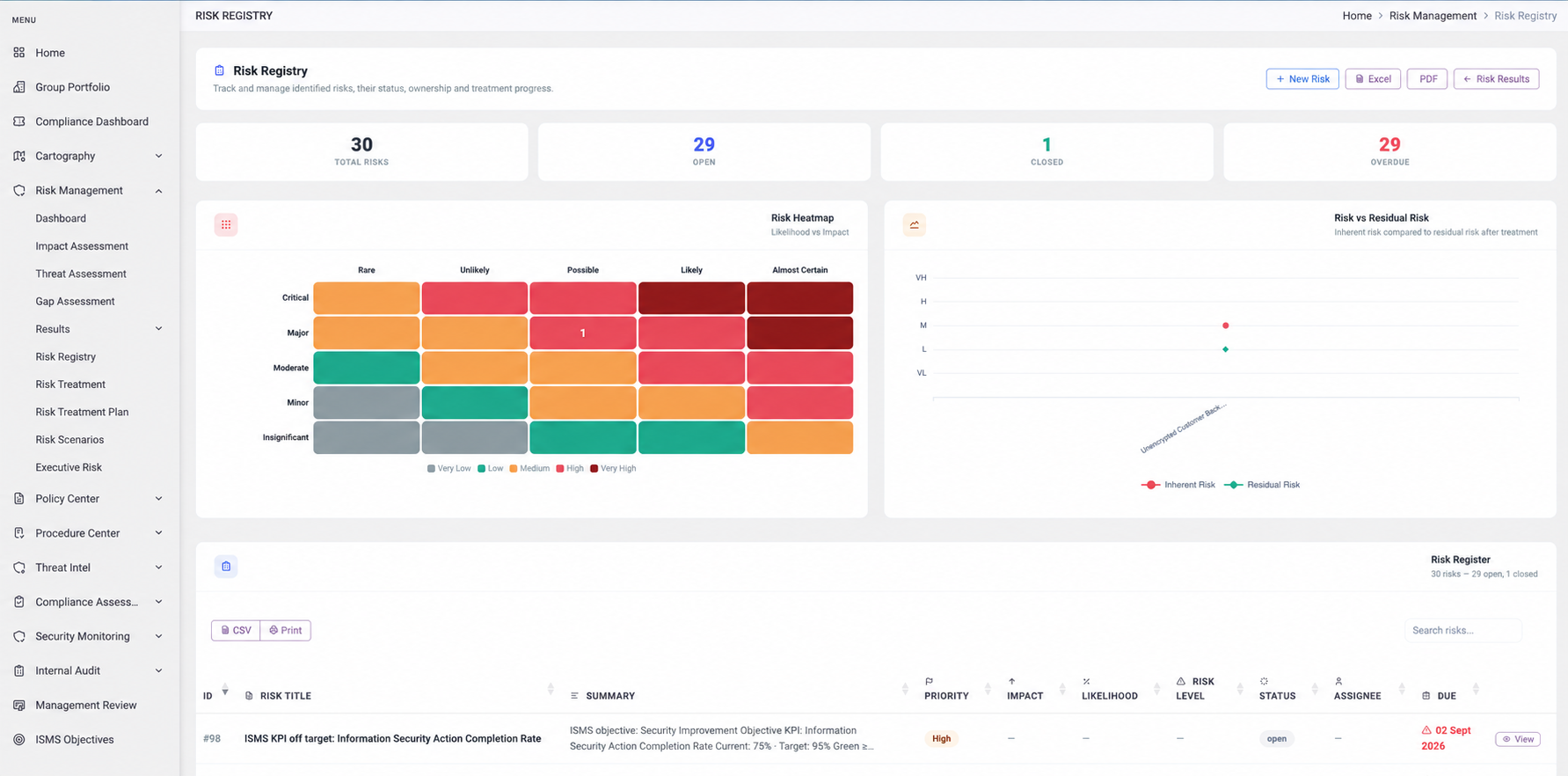
STORM risk registry with heatmap, inherent risk and residual risk
A defined risk journey

Start with the operational environment, not the checklist.

STORM ties cartography, impact and threat assessment to risk scenarios, treatments and residual risk, keeping framework activity connected to the underlying exposure.
  • Asset and dependency cartography
  • Impact, threat and vulnerability assessment
  • Risk register, scenarios and treatment plans
  • Heatmaps and executive risk reporting
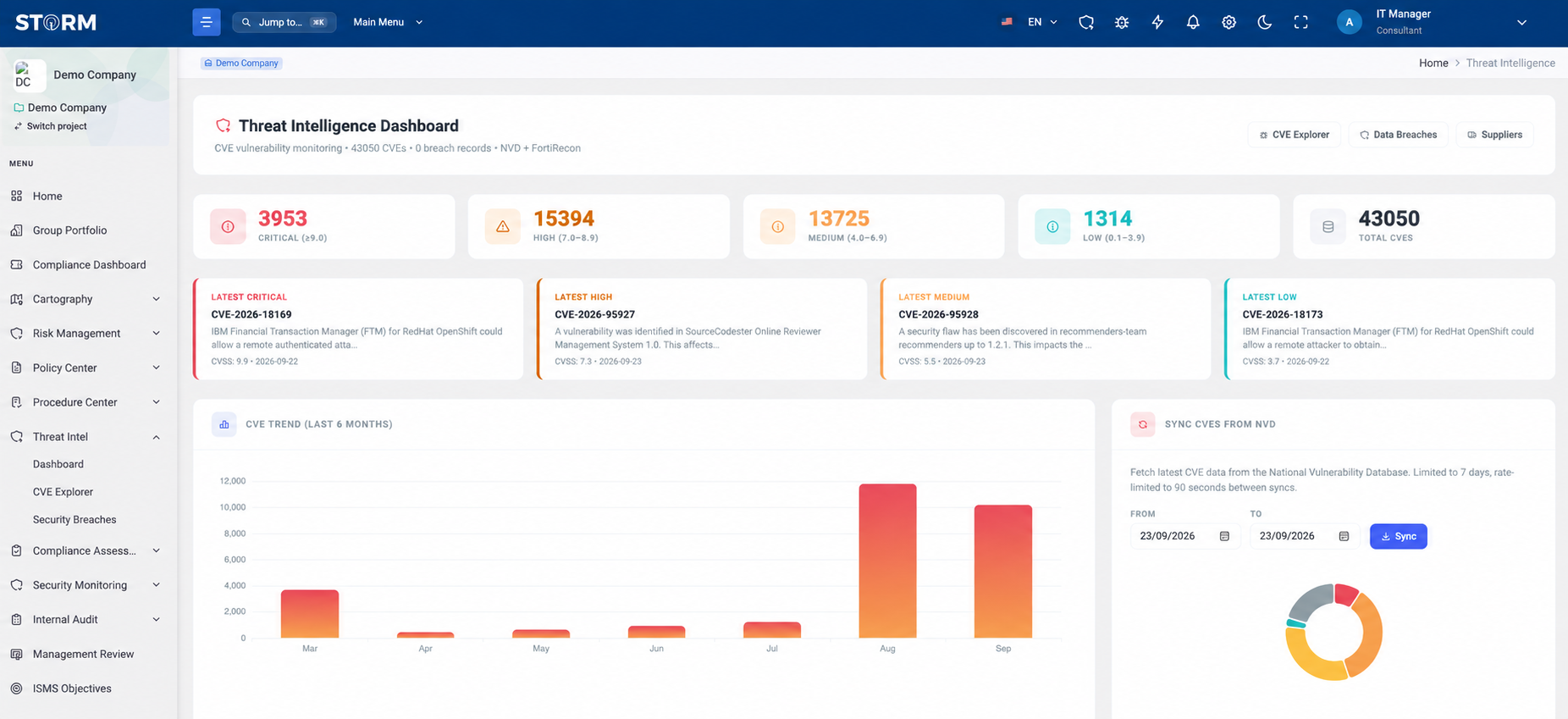
STORM threat intelligence dashboard
Threat context included

Bring external exposure into the risk conversation.

Threat intelligence, CVE and DNS monitoring give security and governance teams additional context for assessment, prioritization and follow-up.
  • FortiRecon threat intelligence integration
  • CVE monitoring and security advisories
  • DNS and external exposure monitoring
  • Context that supports risk prioritization
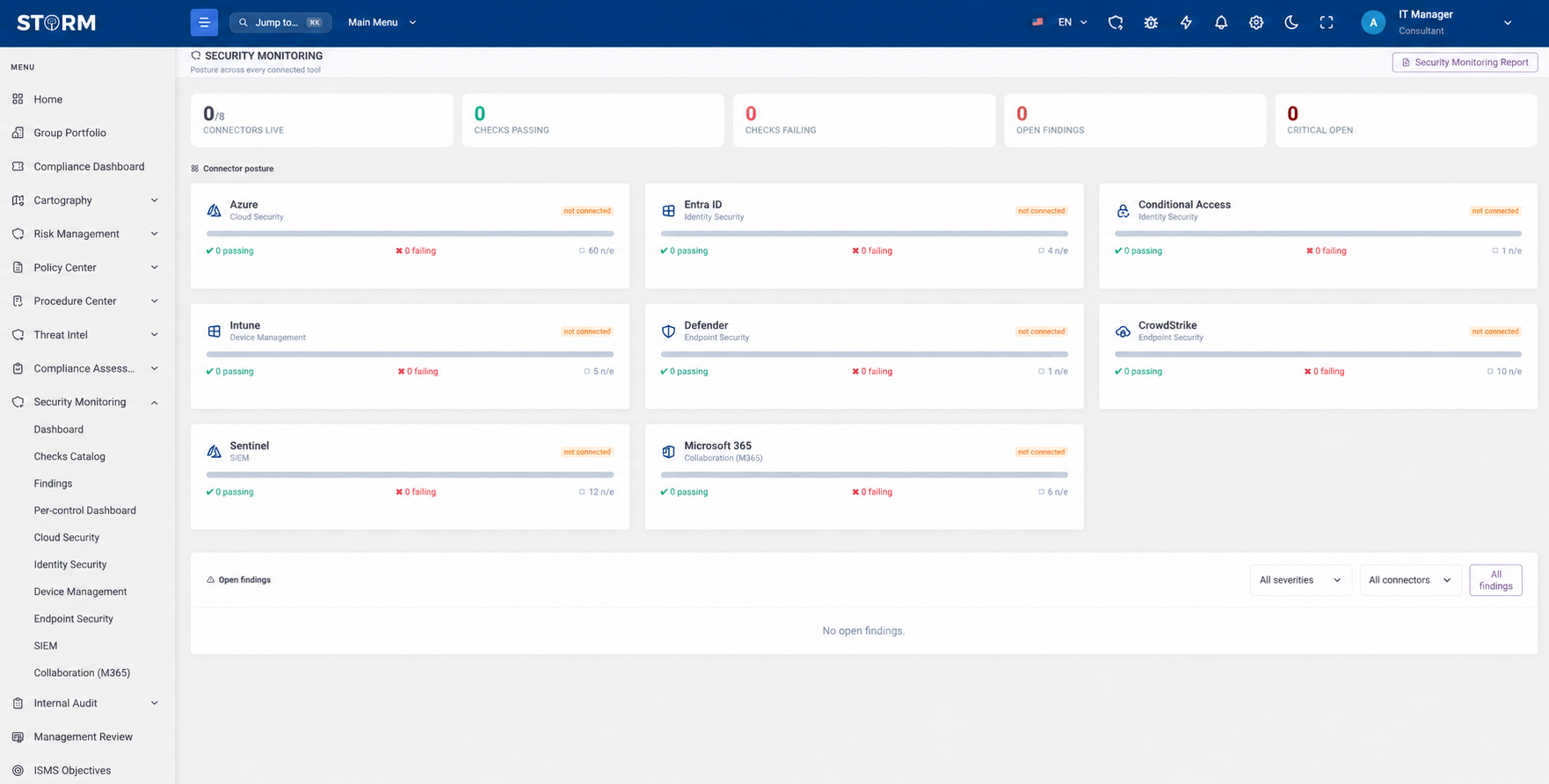
STORM security monitoring dashboard
Evidence in motion

Let operational signals support the audit trail.

Supported MDM and EDR integrations can pre-populate endpoint posture, configuration state and asset attributes. Remediation tasks and findings can then move through the connected governance workflow.

  • Endpoint posture and asset attributes
  • Evidence mapped to relevant controls
  • External supplier ratings in context
  • Tasks synchronized with team workflows
Questions before a shortlist

What should you validate?

Bring your actual assets, risk method, threat sources, evidence workflows, reporting needs and deployment constraints to the STORM demonstration.

Is STORM only a compliance assessment tool?
No. The current STORM site documents twelve modules spanning compliance, risk, audit, incidents, assets, suppliers, BCP/DRP, policies, tasks, phishing, threat intelligence and reporting.
Does STORM include threat intelligence and phishing workflows?
Yes. STORM documents a threat-intelligence module with FortiRecon, CVE and DNS monitoring, plus GoPhish campaigns, templates and analytics for phishing exercises.
Does STORM offer an on-premise option?
STORM is delivered as managed SaaS in EU-based data centers. Its published FAQ says on-premise deployment can be discussed for critical-infrastructure enterprises with strict data-locality requirements. Confirm the architecture and commercial scope during discovery.
Why choose STORM for a connected security and GRC program?
STORM connects assets, risk, controls, audits, incidents, suppliers, continuity, policies, security monitoring and threat intelligence through one shared operating model. It is a strong fit when governance must remain close to operational security context.
See it against your program

Bring your workflows. We'll show the operating model.

Use a 30-minute session to test STORM against your assets, risks, controls, threat sources, reporting needs and deployment constraints.