STORM Platform Cartography
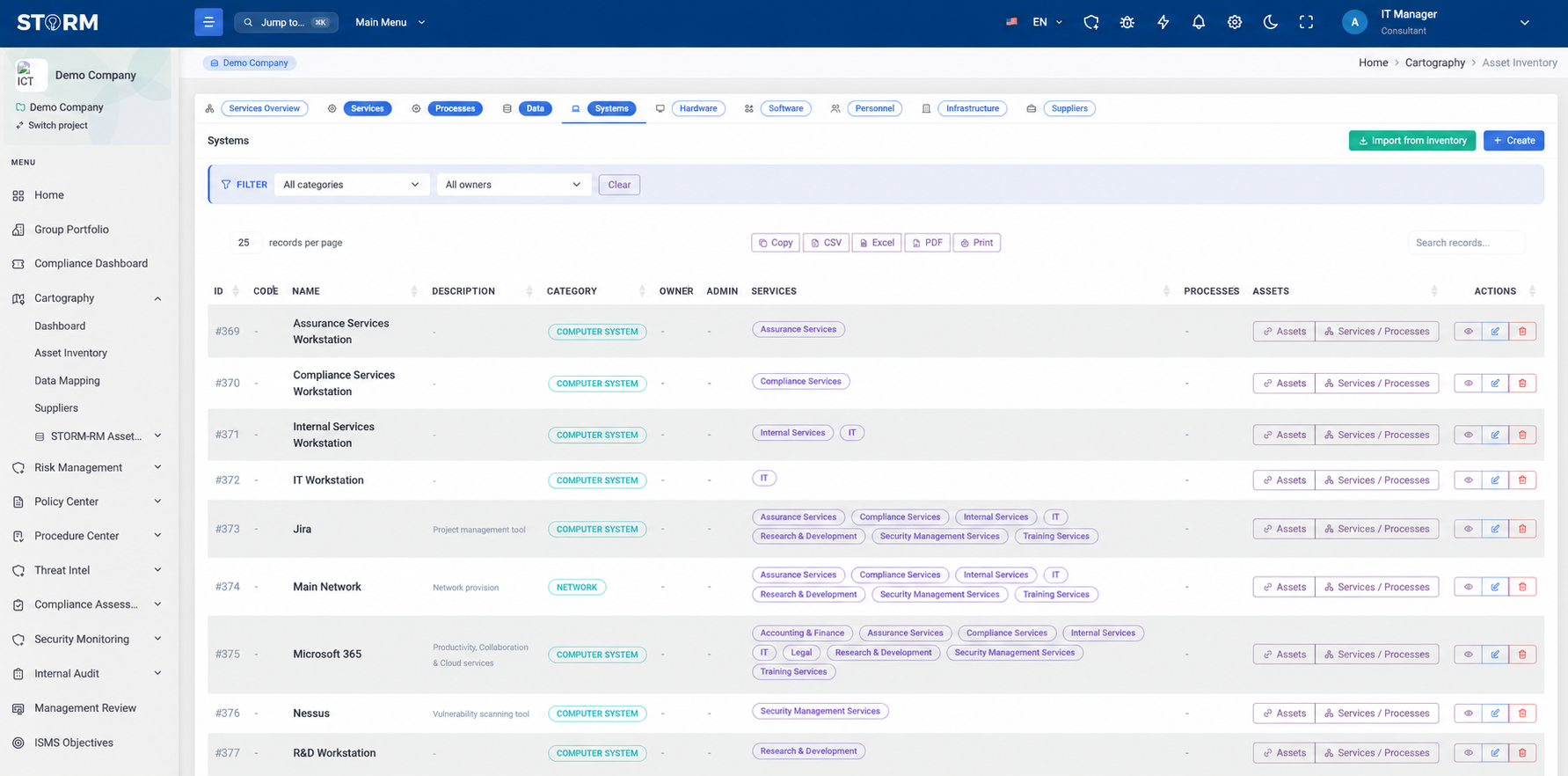
STORM Cartography asset inventory showing systems and their linked services
Move from a business service to its supporting assets without losing the relationship between them.

Put every asset in its business context.

Connect services, processes, data, people and technology in a governed asset model. Give every assessment and action the context of what the organisation actually depends on.

Connected Cartography

Build the operational picture
your teams can work from.

Asset inventories

Maintain services, processes, data, users, locations, hardware and software in a common operational structure.

Explore the asset model
Dependency mapping

Connect business services with supporting assets, internal and external dependencies, and the data moving between them.

See the connected views

Connected risk context

Reuse mapped relationships across impact, threat, vulnerability, risk, incident and third-party workflows.

Follow the context
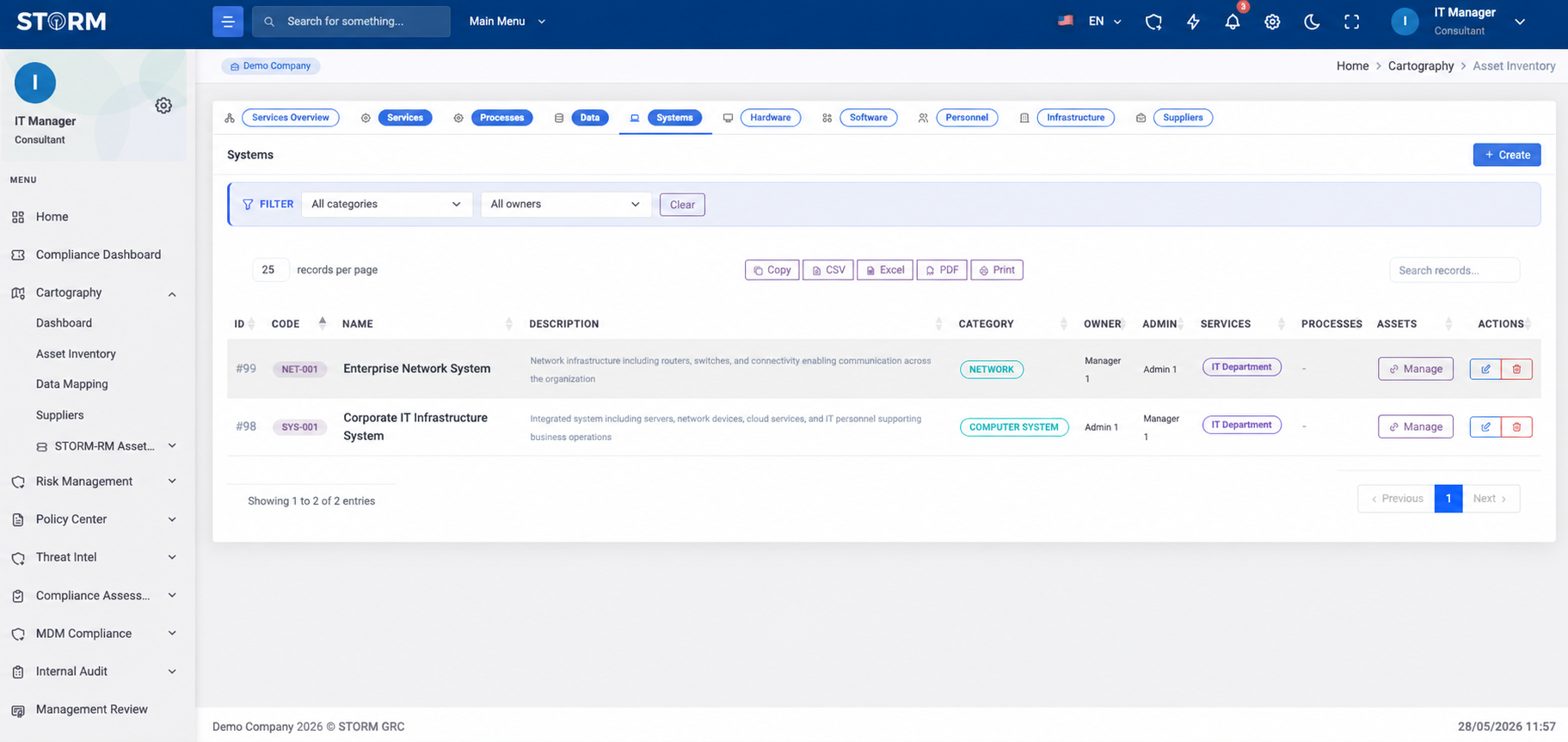
STORM Cartography asset inventory showing systems and their relationships to services
STORM services and processes inventory
Connected asset model

Real relationships, not isolated records.

STORM connects the business view with the technology that supports it. Teams can trace a service through its systems, information and dependencies before they assess impact or risk.

  • Service, process and technology relationships
  • Internal and external system dependencies
  • Asset Inventory & Dependencies reporting
Two sides of the same model

Business context and information context stay connected.

Move from the services the organisation must sustain to the information those services use—without rebuilding the context in separate registers.

STORM services and processes inventory
Business view

Services, processes and the assets behind them

Keep business activity visible when technical assets are assessed.

→
STORM information asset identification interface
Information view

Data identification, mapping and processing context

Support data-flow visibility, ROPA and downstream privacy-impact work.

→
STORM Cartography interface used as the foundation for connected risk workflows
STORM-RM foundation

From business service to operational risk.

Cartography is the first phase of the documented STORM-RM workflow.

Connected workflows

Keep asset context attached to the work that follows.

The same mapped relationships can inform assessment and operational modules across STORM.

Mapped in CartographyServices & processes
informs
Used downstreamImpact and continuity
Mapped in CartographyAssets & dependencies
informs
Used downstreamThreats, vulnerabilities and risk
Mapped in CartographySystems & suppliers
informs
Used downstreamIncidents and third-party oversight
Implementation fit

Clear scope before configuration.

Cartography focuses on governed inventories, relationships and data flows. Align how those records will be populated and maintained before implementation begins.
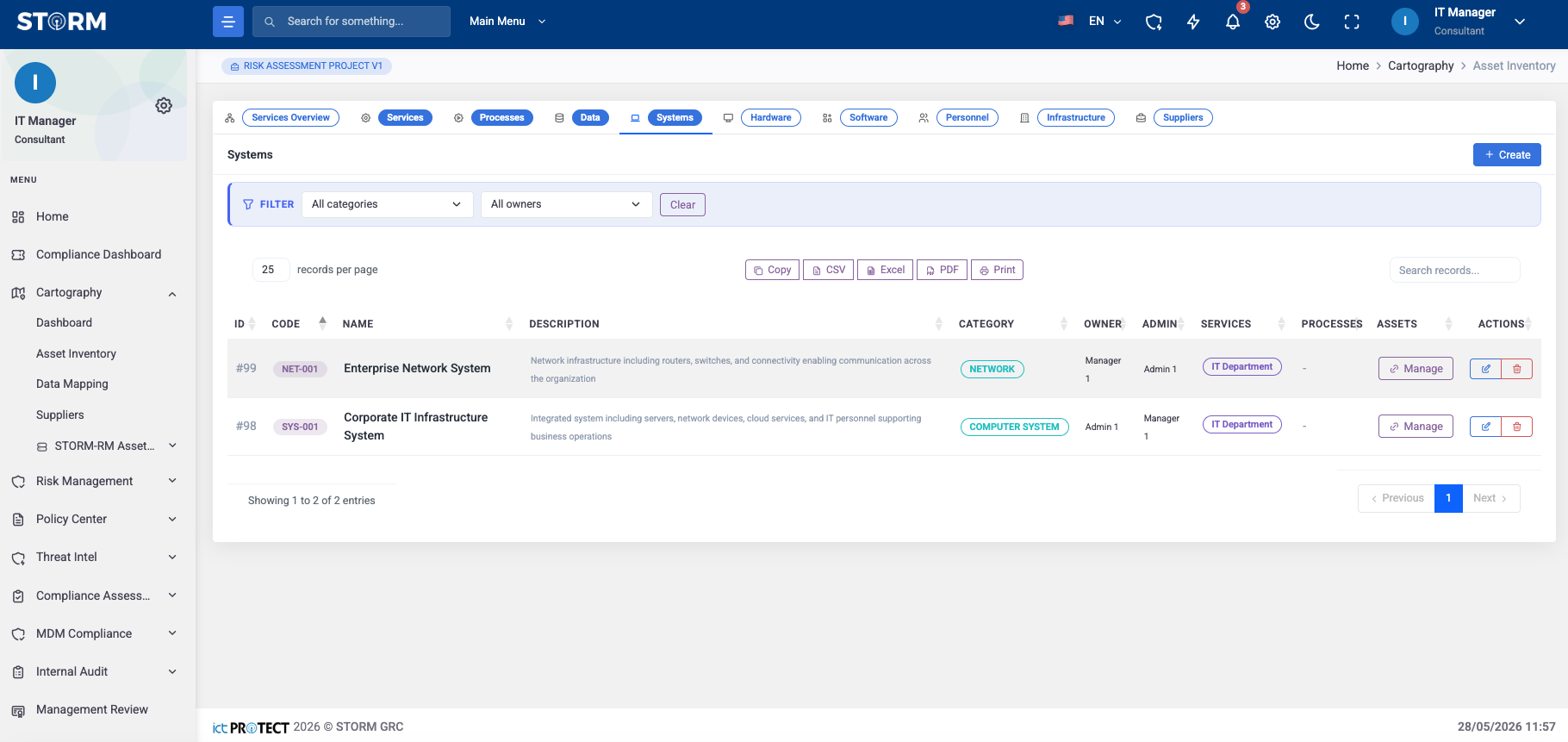
STORM Cartography asset inventory
01

Available in Cartography

  • Services, processes and asset inventories
  • Asset interconnections and dependencies
  • Data identification and data-flow mapping
  • Links into risk, vulnerabilities and incidents
STORM information asset identification interface
02

Confirm for your environment

  • Automatic network or asset discovery
  • Bi-directional CMDB synchronisation
  • Active OT discovery or telemetry ingestion
  • Your import, ownership and refresh model
Practical questions

Evaluate Cartography against your environment.

Bring one critical service, its supporting assets and the registers your teams already maintain to the demo.

Discuss your use case
What can be mapped in STORM Cartography?
STORM covers physical locations, services, data, hardware, software and users. Teams can maintain service and process inventories, information and physical asset lists, system dependencies, data flows and the connected overall asset model.
Does STORM automatically discover network assets?
Automatic network discovery is not listed as a current Cartography capability. STORM is designed to create and maintain governed inventories and the interconnected asset model; the import and maintenance process should be agreed during implementation.
How does Cartography support risk assessment?
Cartography is the first phase of STORM-RM. Mapped assets feed into impact assessment, where confidentiality, integrity and availability consequences are evaluated, and then into threat, vulnerability, risk evaluation and treatment workflows.
Can vulnerabilities and incidents be linked to assets?
Yes. STORM’s Technical Vulnerability Management module can correlate findings with assets in the Cartography Register. Its Security Incident Management module can also record affected assets, systems and services and link incidents to Cartography assets.
Does Cartography cover data mapping and ROPA?
Yes. STORM includes data identification, GDPR data mapping, identification of data flows and preparation of Records of Processing Activities. It also supports a downstream Data Protection Impact Assessment workflow.
Does Cartography replace a CMDB?
STORM does not position Cartography as a CMDB replacement or list bi-directional CMDB synchronisation as a current capability. It should be evaluated as the governed asset-and-dependency context used by STORM’s risk and compliance workflows.
A focused product walkthrough

Bring one critical service. Map what it really depends on.

Validate the asset taxonomy, dependency model, data flows and how that context carries into the work your teams already do.

Book a STORM demo
STORM services and processes inventory
STORM Cartography connected asset model